Introduction
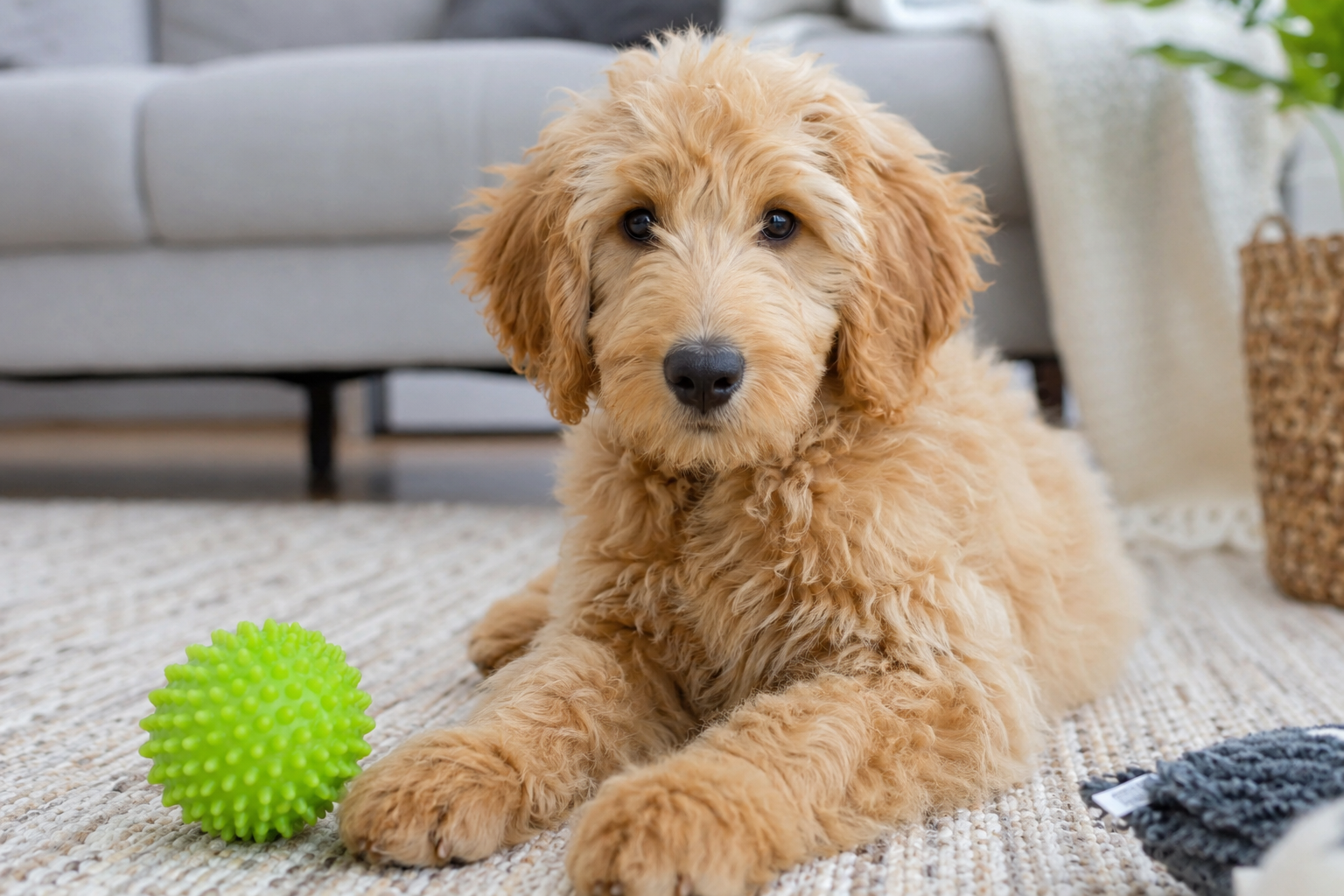
The F1 Goldendoodle is one of the most popular family dogs today, known for its friendly personality, intelligence, and soft teddy bear appearance. It is a first-generation cross between a purebred Golden Retriever and a purebred Poodle.
This combination creates a dog that is affectionate, social, highly trainable, and visually appealing. However, many new owners do not fully understand what “F1” means or how it affects coat type, shedding, size, and temperament.
Understanding these factors is important before choosing a puppy because F1 Goldendoodles can vary significantly even within the same litter. Some may look more like Golden Retrievers, while others may inherit more Poodle traits.
This guide explains everything you need to know about F1 Goldendoodles, including coat types, shedding, size, temperament, grooming, training, health, and common myths.
What Is an F1 Goldendoodle?
An F1 Goldendoodle is the result of breeding a purebred Golden Retriever with a purebred Poodle. The puppies are approximately 50 percent Golden Retriever and 50 percent Poodle.
Because both parents are purebred, F1 Goldendoodles are considered first-generation hybrids. This means they often show a balanced mix of traits from both breeds, although not in equal or predictable proportions.
Some puppies may inherit more retriever-like features such as a straighter coat and heavier shedding, while others may take after the Poodle with curlier coats and lower shedding.
This genetic variation is one of the defining characteristics of the F1 generation.
F1 Goldendoodle Genetics Explained
Each puppy inherits a unique combination of genes from both parents. This is why puppies in the same litter can look completely different.
Genetics influence several traits including coat texture, coat color, size, facial structure, and shedding levels. Unlike purebred dogs, hybrid breeds like the F1 Goldendoodle do not have fixed physical outcomes.
Some puppies may have wavy coats, while others may have straight or curly coats. This unpredictability is normal and part of what makes F1 Goldendoodles unique.
F1 Goldendoodle Coat Types
F1 Goldendoodles can have three main coat types, each with different grooming and shedding characteristics.
Straight Coat
Straight-coated F1 Goldendoodles resemble Golden Retrievers. Their coats are smooth, soft, and lie flat against the body. These dogs tend to shed more compared to other coat types and are less suitable for allergy-sensitive households.
Wavy Coat
Wavy coats are the most common and are often referred to as the classic Goldendoodle look. The coat is soft, slightly curly, and low to moderate shedding. This type is highly popular due to its teddy bear appearance and manageable grooming needs.
Curly Coat
Curly-coated F1 Goldendoodles resemble Poodles more closely. Their coats are dense, tight, and shed the least among F1 variations. However, they require more frequent brushing and professional grooming to prevent matting.
F1 Goldendoodle Coat Colors
F1 Goldendoodles come in a wide variety of colors due to the genetic diversity of both parent breeds.
Golden
Golden is the traditional color associated with Golden Retrievers. It is warm, bright, and often very photogenic. It is one of the most commonly seen F1 Goldendoodle colors.
Cream
Cream Goldendoodles have light ivory or beige coats. They often appear soft and elegant but may require more grooming to maintain a clean appearance.
Apricot
Apricot is a warm peach-toned color that is very popular among families. It gives puppies a soft teddy bear look and may lighten as they mature.
Red
Red Goldendoodles have deep copper or mahogany-colored coats. They are highly desirable and often stand out due to their rich pigmentation.
Chocolate
Chocolate Goldendoodles have brown coats ranging from light milk chocolate to dark cocoa. This color is eye-catching but may fade slightly over time.
Black
Black F1 Goldendoodles have glossy, solid coats that are less common but very striking. Their coats often require less visible maintenance compared to lighter colors.
Do F1 Goldendoodles Change Color?
Yes, many F1 Goldendoodles change color as they grow. This is due to a natural genetic process known as fading.
The fading gene is more commonly inherited from the Poodle side of the family. Puppies may begin to change color between six months and two years of age.
Common changes include red fading to apricot, chocolate fading to café tones, and black becoming charcoal or silver. Not all dogs experience strong fading, but it is very common in this generation.
Do F1 Goldendoodles Shed?
F1 Goldendoodles do shed, but the amount varies depending on coat type.
Straight coats shed the most because they resemble the Golden Retriever parent. Wavy coats shed moderately, while curly coats shed the least.
However, no Goldendoodle is completely non-shedding. Even low-shedding dogs still produce dander, which is the primary trigger for allergies.
Are F1 Goldendoodles Hypoallergenic?
F1 Goldendoodles are not fully hypoallergenic. While some individuals may be more suitable for allergy-sensitive owners, no dog breed is completely allergen-free.
Curly-coated F1 Goldendoodles tend to be the most allergy-friendly due to reduced shedding. However, reactions can vary depending on the individual dog and the person.
F1 Goldendoodle Size
F1 Goldendoodles come in three main size categories depending on the size of the Poodle parent.
Standard
Standard F1 Goldendoodles typically weigh between 50 and 75 pounds and stand around 20 to 26 inches tall. They are active, strong, and require more space.
Medium
Medium F1 Goldendoodles usually weigh between 35 and 50 pounds. They are balanced in size and are ideal for families who want a manageable but active dog.
Mini
Mini F1 Goldendoodles range between 15 and 35 pounds. They are ideal for apartments or smaller homes while still maintaining an energetic and playful personality.
F1 Goldendoodle Growth Stages
F1 Goldendoodles grow quickly in their first year.
Between 8 weeks and 4 months, they experience rapid development and high energy. From 4 to 8 months, they become more independent and begin testing boundaries. Between 8 and 12 months, growth slows and adult behavior starts to develop.
By 12 months, most F1 Goldendoodles are close to their full size, although some may continue filling out until 18 months.
F1 Goldendoodle Temperament
F1 Goldendoodles are known for their friendly, affectionate, and social personalities. They are highly people-oriented and enjoy being part of family life.
They are generally good with children and other pets when properly socialized. Their intelligence makes them easy to train, but they also require mental stimulation to prevent boredom.
Because they form strong emotional bonds, they do not enjoy being left alone for long periods.
Intelligence and Trainability
F1 Goldendoodles are highly intelligent due to the combination of Poodle and Golden Retriever genetics. They respond well to positive reinforcement and can learn commands quickly.
They excel in obedience training, agility activities, and structured routines. However, their intelligence also means they need consistent mental engagement.
Exercise Needs
F1 Goldendoodles are active dogs that require daily exercise. On average, they need 30 to 60 minutes of physical activity per day.
This can include walks, playtime, training sessions, or outdoor activities. Without sufficient exercise, they may develop unwanted behaviors such as chewing or excessive barking.
Grooming Requirements
Grooming needs depend on coat type, but all F1 Goldendoodles require regular maintenance.
They should be brushed at least two to four times per week to prevent matting. Bathing is typically needed every four to six weeks. Professional grooming is recommended every six to eight weeks to maintain coat health.
Living Environment
F1 Goldendoodles adapt well to different living environments, including houses and apartments, as long as their exercise and social needs are met.
They thrive in homes where they receive attention, interaction, and daily activity. Mini F1 Goldendoodles are especially suited for smaller living spaces.